
Art through the Ages Pre-historic to Contemporary
At Branch Out Art Studio, art history isn’t dusty or distant - it’s a launchpad for imagination. When kids learn about the artists, movements, and styles that shaped the art world, they gain powerful tools to bring more meaning, confidence, and originality to their own creations.
In our classes, young artists explore iconic artworks and creative change-makers from across time, then roll up their sleeves to make beautiful, frame-worthy pieces of their own. Along the way, they discover why art is made, experiment with new techniques, and learn how culture, ideas, and emotions can shape what ends up on the page or canvas.
Seeing how artists throughout history solved problems, expressed big feelings, and even challenged the world around them sparks fresh ideas and brave thinking. It helps children understand that art can tell stories, share messages, and make an impact.
The result? Thoughtful, expressive artwork that looks stunning and reflects real growth pieces filled with curiosity, skill, and personality, treasures to be proud of for years to come.
PROGRAM OVERVIEW
Our 9 week term runs across scheduled weekly sessions, with the option to enrol for the full term or book individual classes (subject to availability). Each session includes guided instruction, creative exploration, and time to develop skills using high-quality art materials in a supportive studio environment.
9 WEEK TERM DATES
Saturday 2nd May - 27th June 2026
Branchlings (Ages 5-8) 2 hours
$360 for term or $40 per session
Saplings (Ages 8-12) 3 hours
$450 for term or $50 per session
Full Day (Ages 5-12) 6 hours
$810 for term or $90 per session
Branchlings (Ages 5-8)
Term Outline: What We’ll Discover Each Week
Classes run from 10am - 12pm ・2 Hours of Creative Studio Time
-
A calm and friendly arrival time where little artists get comfortable, connect, and prepare for the creative adventure ahead.
-
Ancient Art (Pre-historic)
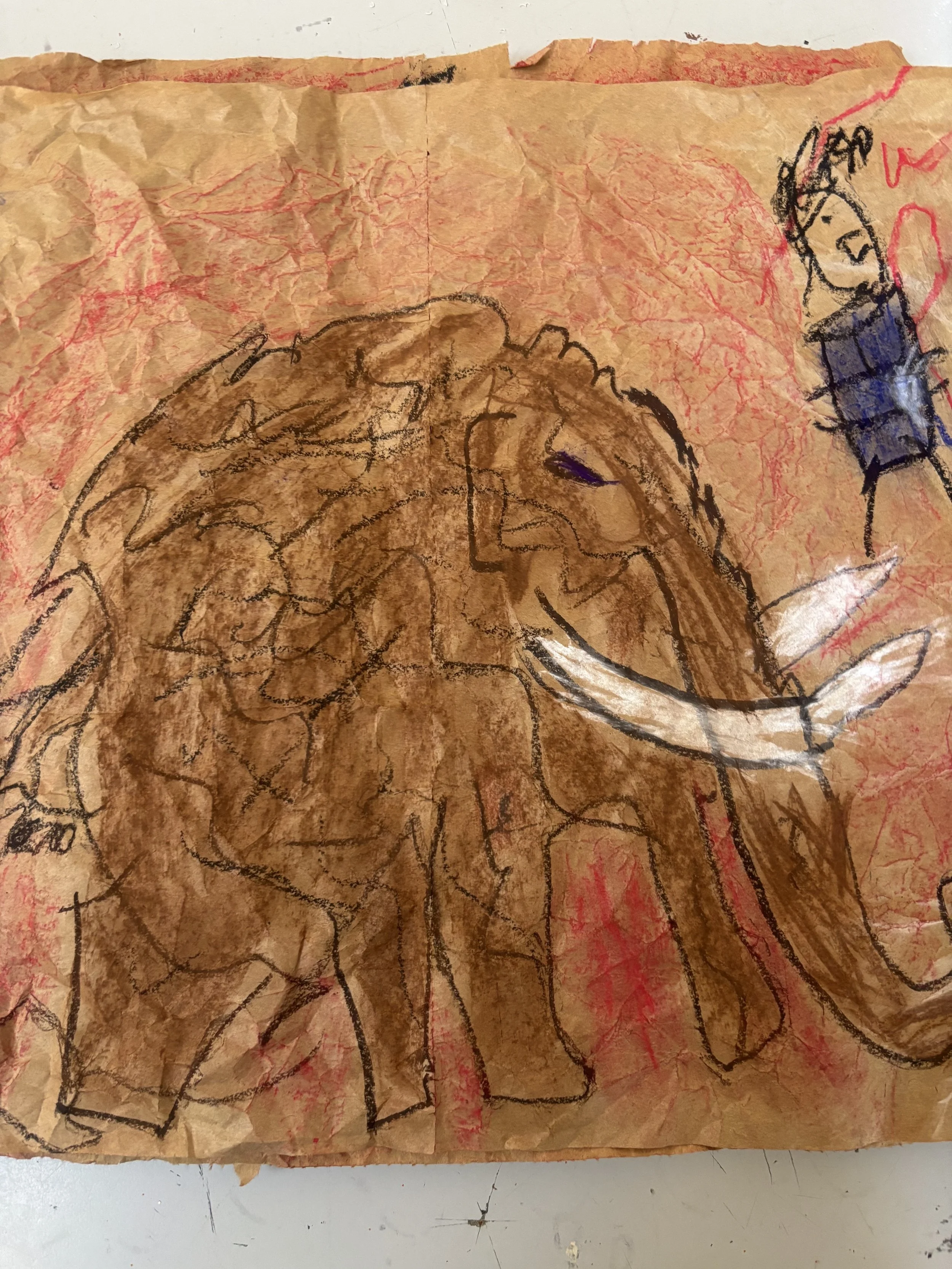
Oh yes — let’s make it rock. We’re stepping back in time… way back.
In this hands-on session, young artists will scrunch, crinkle and shape paper to transform it into a textured “rock wall,” just like the caves our earliest ancestors once painted on. Once our walls are formed, it’s time to become prehistoric storytellers.
There’s no fancy tools, just imagination and a whole lot of stone-age style. Kids will create their own cave-inspired artworks using earthy tones, and simple symbols. They’ll explore how the original rockstars used art to communicate and record stories.
From ancient caves to the Branch Out Studio — great ideas are truly set in stone.
PLUS
Egyptian Art (c. 3000–30 BCE)
In this session, we’re travelling back to Ancient Egypt — where pyramids touch the sky, queens rule with confidence, and even cats live a life of luxury.
This lesson blends storytelling, history and colour theory. It’s the purr-fect mix of art skills and imagination.
Inspired by the book Mummy Cat by Marcus Ewert, we’ll imagine what might happen if Queen Hatshepsut’s beloved feline suddenly woke from his mummified nap and decided to prowl the pyramids once more.
As we create, we’ll explore warm and cool colours, learning how fiery reds, oranges and yellows can glow like desert sun, while blues, greens and purples bring the cool mystery of pyramid shadows. Students will use colour choices thoughtfully to make their feline truly come to life — no mummy-fication required.
Don’t be in de-NILE… this class is going to be royally fun.
-
Classical Art – Ancient Greece and Rome (c. 800 BCE–400 CE)
We’re heading back to Ancient Greece — where legends were born, heroes trained hard, and olive wreaths were the ultimate prize.
In this session, young artists will create a portrait of themselves as a mighty ancient Olympian. Think flowing robes, strong stances, determined expressions… and maybe a little god-like glow.
No podium selfies or gold medals back then - Instead, winners were crowned with a wreath made from the leaves of a sacred olive tree.
As we draw, we’ll explore portrait techniques, proportions and powerful poses to capture that victorious energy. This is your chance to flex those creative muscles — no discus throwing required.
-
Step right up — we’re heading to Ancient Rome!
The Colosseum has been turning heads for nearly 2,000 years
Before we even begin drawing those iconic arches, we’ll treat our paper to give it that cracked, weathered, stone-like effect. A surface that looks wonderfully ancient and gloriously gladiator-ready.
Artists will carefully build the Colosseum’s repeating arch shapes, exploring pattern, symmetry and bold outlines. Then comes the fun part — adding glowing windows, dramatic skies and vibrant foreground details to make their masterpiece arena-worthy.
We’ll chat about how this enormous amphitheatre once held roaring crowds (no microphones required) and why it still stands tall today.
This project blends history, texture and architecture. It’s big, bold and full of ancient wow-factor. All roads lead to Branch Out Art Studio.
-
Middle Ages (Medieval Art) (c. 400–1400)
Court Jester. When laughter mysteriously disappears from the kingdom the Court Jester must seek far and wide to find it again. He knows that only laughter can solve the problems around him. This artwork features a fun-to-paint court jester/talented juggler who can keep six colored balls in the air, which happen to be in the rainbow of the realm order! Kids will enjoy the magic of colour mixing discovering how colours change and blend before their eyes. Along the way, artists will add expressive details and playful touches to make their jester truly unique. This session celebrates fun, creativity and storytelling, reminding us that sometimes a little colour and laughter can solve just about anything.
-
Unicorn and Lion Banner Time to raise your standard (literally) - this project is going to be roar-some. A magical lesson putting a sparkly, imaginative twist on the banners flown during Medieval and Renaissance times. Young artists will design and draw a whimsical lion or unicorn to feature proudly on their very own banner, inspired by symbols of bravery, strength and magic.
Children will explore balance and symmetry as they add a decorative pendant to the bottom of their banner, then finish with a wooden hanger and ribbon. Bursting with personality and creative flair, these banners are made to proclaim their presence—whether to loyal comrades or imaginary foes. A joyful blend of history, design and storytelling, perfect for bold and brave young artists. Hear ye, hear ye — creativity is in session.
-
Renaissance (c. 1400–1600)
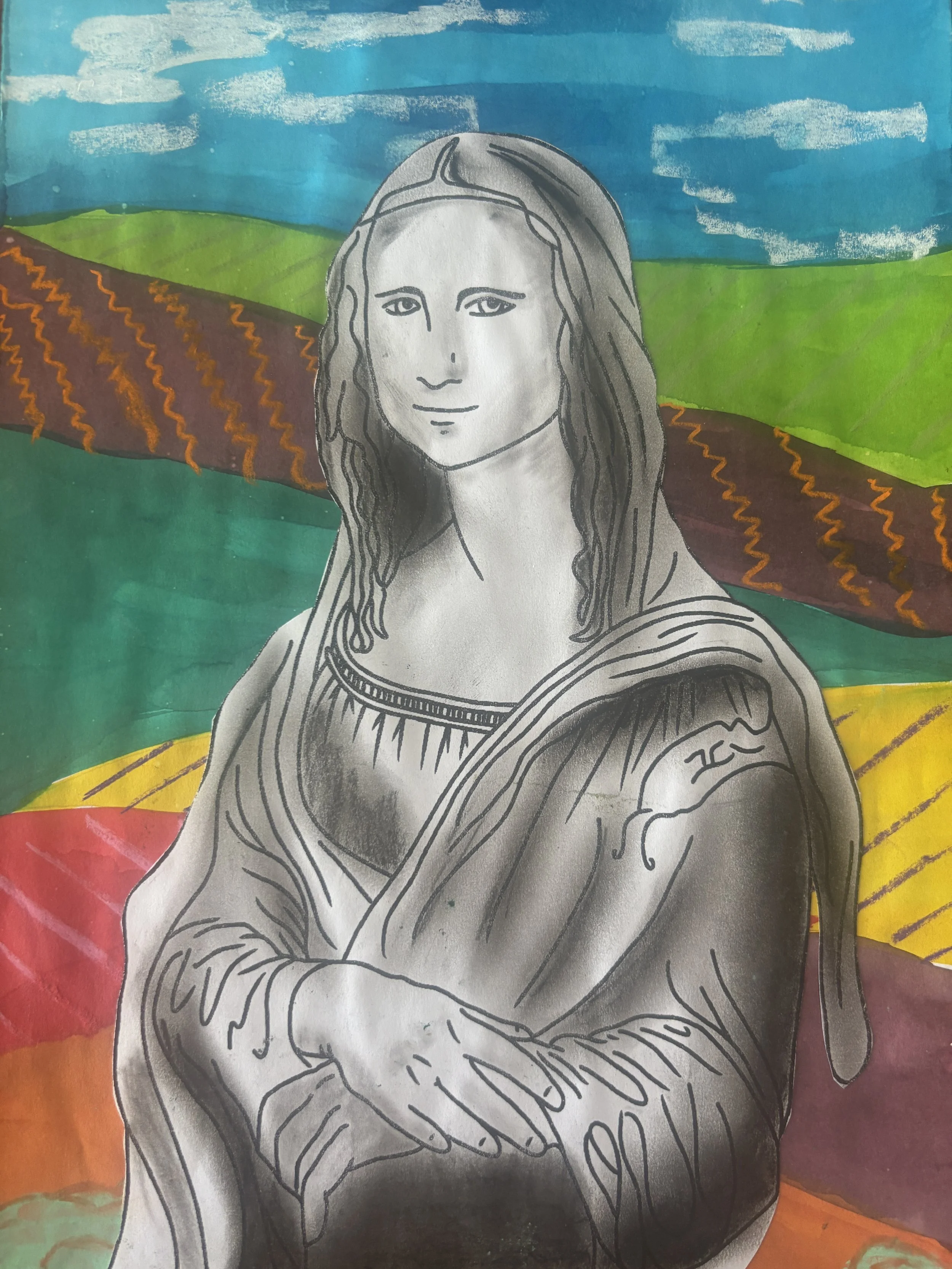
Mona Lisa Chalk Drawing. Mona Lisa from the Renaissance, with the world’s most famous resting art face, meets kids from Gen Alpha. The ‘Value’ (‘xcuse the pun) of this project is about all the shadows and highlights that make Mona special for her time. The final addition of a colourful, bold background that adds fun, contrast and personality. This session blends classical art techniques with contemporary flair, helping children understand why Mona was special in her time—while making her feel fresh, playful and totally their own. This session is truly smile-worthy.
PLUS
da Vinci sketchbook. In this creative lesson, young artists will step into the world of Leonardo da Vinci, making coffee-stained paper and a personalised sketchbook that’s bound to impress. ready for ideas, drawings and discoveries.
Just like da Vinci, who filled thousands of pages with art, inventions and scientific observations, children will be encouraged to sketch, experiment and let their curiosity take the lead-o-nardo. No need for 13,000 pages — we’ll keep it short and sketchy. This session celebrates imagination, inquiry and the joy of recording ideas, creating a keepsake sketchbook to treasure long after class ends.
-
Romance / Romanticism (late 1700s–mid 1800s)
The Swing: Poetry in Motion inspired by the joyful childhood poem The Swing by Robert Louis Stevenson, this lesson captures that delicious feeling of flying high through the air with carefree abandon. Reaching new heights of delight, young artists will explore the idea of movement, freedom and play as they create a beautifully layered artwork full of texture and charm. Using a mix of materials and techniques, kids will build an artwork reminiscent of the dreamy, flowing style seen in paintings by Jean-Honoré Fragonard. A favourite surprise feature? The swing really moves back and forth! This interactive element brings the artwork to life. Rich, playful and full of motion, this session truly is in full swing
-
Impressionism (c. 1860s–1880s)
Monet’s Sailboats. Ready to make a great impression? In this dreamy lesson, young artists will discover the magic of art in motion with this Monet-inspired, reflection artwork. Improvisation and risk taking are encouraged today. Monotypes happen in the process of being made, colours will blur, reflections will shimmer and unexpected results will appear, prompting plenty of oohs and aahs along the way. A little Monet magic goes a long way. Both provocative and playful, this lesson celebrates risk-taking and rewards artists with a beautifully atmospheric artwork that captures the joy and mystery of Monet’s world.
PLUS
Post-Impressionism (c. 1880s–1900)
Van Gogh – Wheat Field with Cypresses 1889
The Post-Impressionists wanted to create art with deeper meaning and they used colour to express their emotions rather than to create super realistic images. In this thoughtful and joyful lesson, our little Branchlings will explore how colour can express emotions, memories and ideas. Children will ponder questions like: What colours make me feel happy? What colour is the sky in my imagination? What colours belong to hills and mountains? Along the way, artists will be gently introduced to the idea of atmospheric perspective—sounds fancy, hey? But with friendly words like foreground, horizon line, hills, mountains and swirling skies, it quickly becomes a walk in the park. This lesson encourages curiosity, confidence and personal expression, helping children create a landscape that reflects how they see and feel the world around them.
Let’s go with Van Gogh and colour your world your way.
-
Expressionism, Fauvism,Cubism (early 1900s – 1920s)
Kandinsky ‘Squares with Concentric Circles’ 1913
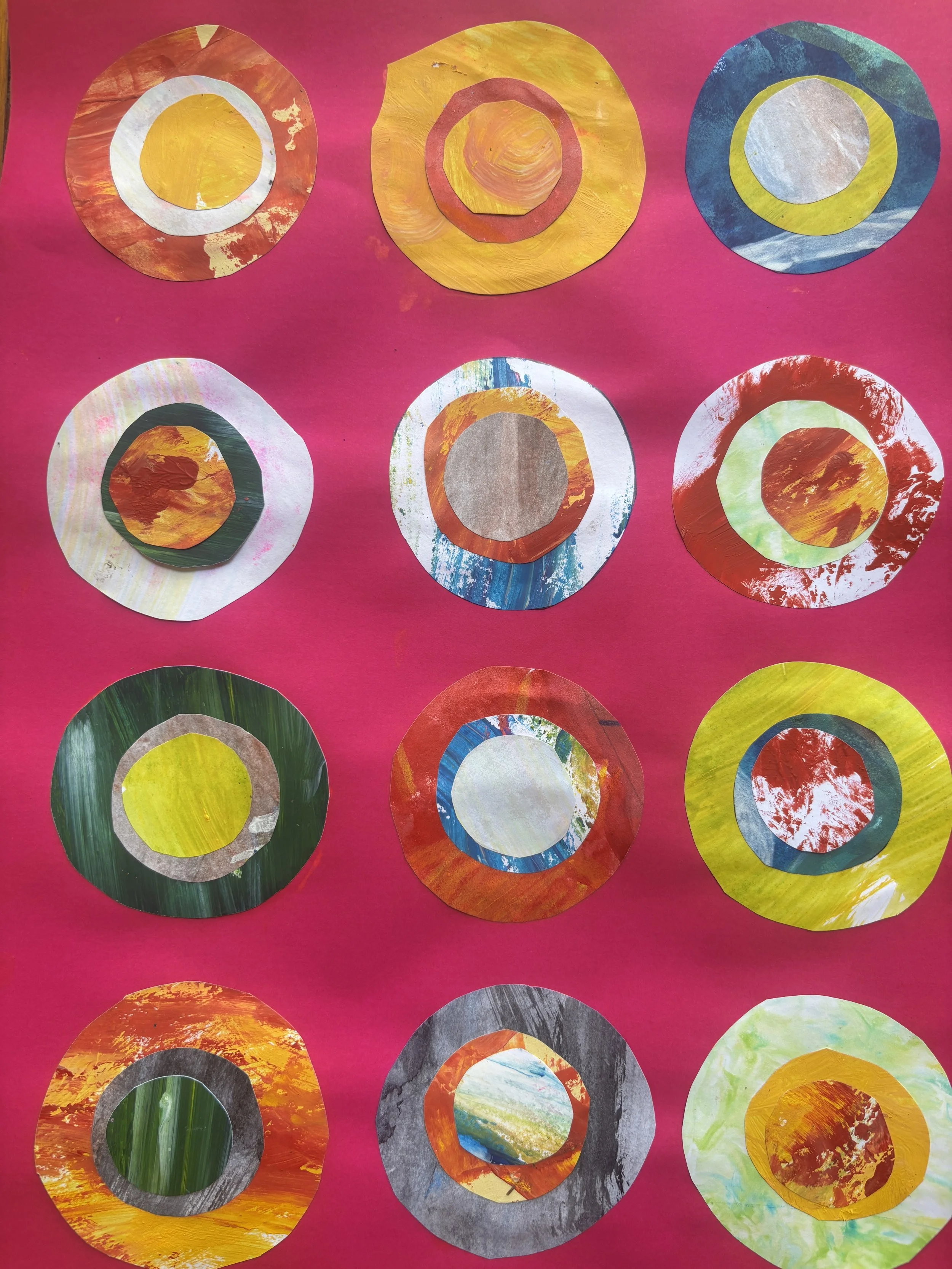
After reading the story of ‘The Noisy Paintbox’, a book about Wassily Kandinsky’s childhood years, little artists will explore concentric circles, bold colour and striking contrast in this hands-on collage session. Children will experiment with layering, placement and colour relationships while building confidence to trust their instincts and make creative choices. This session really hits the spot and celebrates process over perfection, encouraging curiosity, problem-solving and joyful artmaking as each child creates a unique, vibrant artwork that truly comes full circle.
PLUS
Orphism, Op Art and Pop Art (1950s–1970s)
Vasarely Zebra. What is black and white and wobbly all over?
In this eye-catching lesson, young artists will step into the world of Op Art, inspired by one of its most important artists, Victor Vasarely, and his famous artwork Zebra. Children will explore how curving lines can run together, twist and bend to create the illusion of movement, space and form. Things are about to get a little wild.
Kids will cut, rearrange and piece shapes back together to build their own playful zebra. A bold, bulging, hot, savannah sun in the background adds another layer of visual magic, helping the artwork appear to pop and move before their eyes. This lesson encourages experimentation, problem-solving and joyful discovery, proving that Op Art can be clever, curious and lots of fun.
A real optical pop-portunity.
Classes may vary slightly from the planned schedule from time to time to best support the group’s creativity and flow.
Saplings (AGES 8-12)
Term Outline: What We’ll Discover Each Week
Classes run from 1pm - 4pm ・3 Hours of Creative Studio Time
-
A calm and friendly arrival time where little artists get comfortable, connect, and prepare for the creative adventure ahead.
-
Ancient Art (Pre-historic)
Head of a Bull. Art that rocks. We’re stepping back in time… way back.
In this hands-on session, young artists will scrunch, crinkle and shape paper to transform it into a textured “rock wall,” just like the caves our earliest ancestors once painted on. Once our walls are formed, it’s time to become prehistoric storytellers.
There’s no fancy tools, just knowledge and a whole lot of stone-age style. Kids will create their own Lascaux cave-inspired artworks using earthy tones, and simple strokes. They’ll explore how the original rock-stars used art to communicate and record stories.
From ancient caves to the Branch Out Studio — great ideas are truly set in stone.
PLUS
Egyptian Art (c. 3000–30 BCE)
Scarab Beetle
Step back in time and roll into Ancient Egypt. Inspired by ancient Egyptian design, artists will create their own richly patterned scarab artwork using symmetry, line, shape and decorative pattern. Just like Egyptian artisans, students will work carefully and thoughtfully, building bold outlines, repeating motifs and vibrant colour details worthy of a pharaoh’s treasure collection.
As they create, artists will explore how Egyptians believed the scarab rolled the sun across the sky each day. Through guided drawing and decorative design, students will learn how art was used to tell stories, express beliefs and celebrate life thousands of years ago. This session encourages patience, precision and creativity while helping young artists come out of their shell and transform ideas into striking symbolic art.
-
Classical Art – Ancient Greece and Rome (c. 800 BCE–400 CE)
Medusa
Get ready to snake a look into Greek mythology, where legends, monsters and creativity collide! In this striking mixed-media lesson, young artists will meet Medusa — one of Ancient Greece’s most fascinating mythical figures, famous for her spectacular snake hair and powerful gaze. Artists will design their own bold Medusa portrait while exploring line, texture and relief sculpture techniques. Using layered materials, raised forms and expressive mark-making, students will bring Medusa’s wriggly, twisty snakes to life, creating movement that practically slithers off the page.
Artists will frame their work with decorative borders inspired by Ancient Greek patterns and pottery design while learning how myths were used to explain the world, tell stories and spark imagination thousands of years ago.
PLUS
Roman Busts
History set in stone! In this hands-on mixed-media lesson, young artists will create their own classical portrait bust, inspired by the sculptures that once lined temples, theatres and grand city spaces.
Artists will explore how Ancient Greek and Roman sculptors celebrated heroes, thinkers and everyday people through carefully observed facial features, flowing hair and beautifully draped clothing. Using drawing, shading and layered collage techniques, students will design a portrait that proudly sits upon its very own pedestal.
Young creators will experiment with light, shadow and proportion to give their sculptures a timeless, marble-like appearance — no chisel required!
-
Middle Ages (Medieval Art) (c. 400–1400)
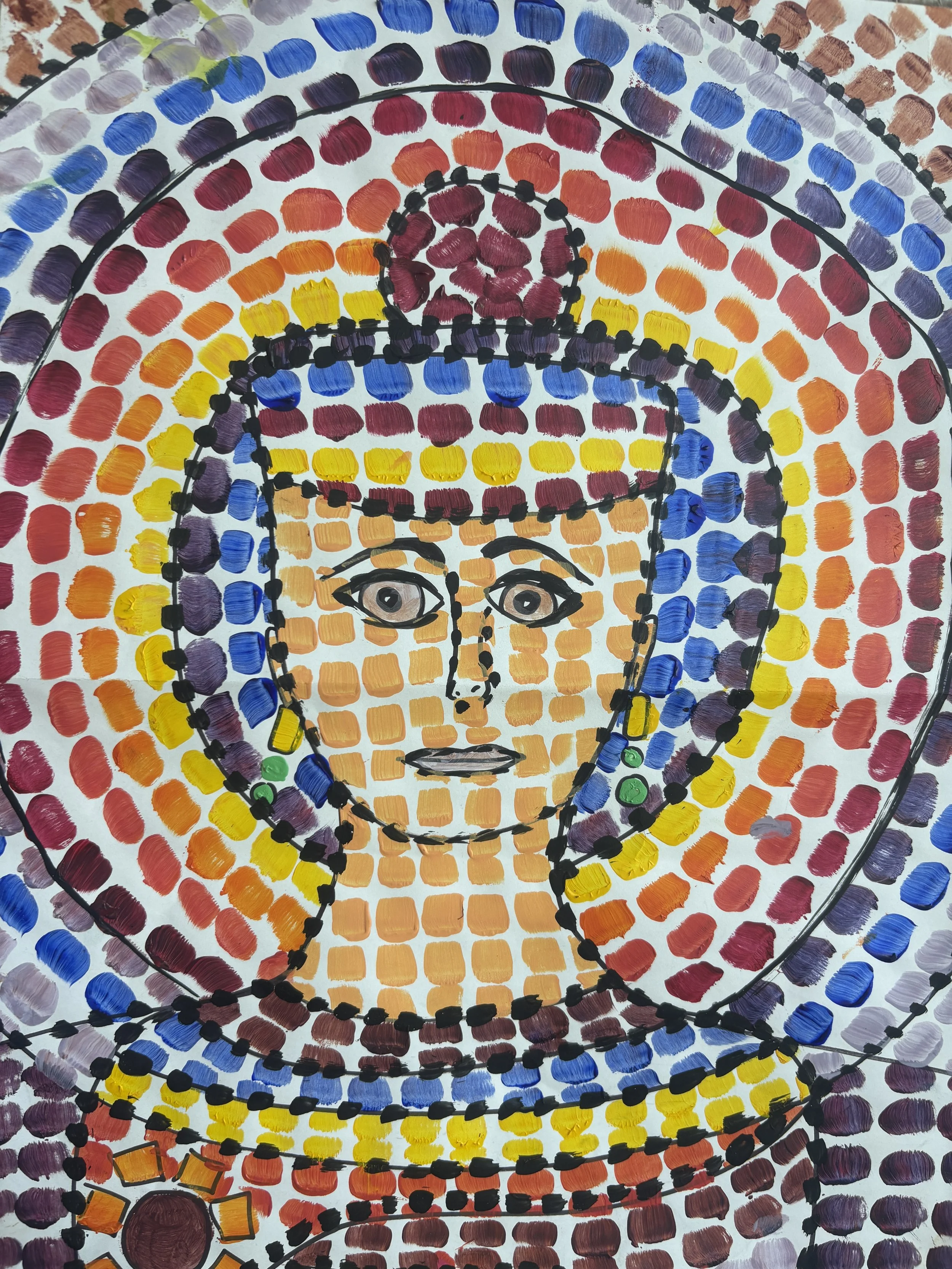
Byzantine Mosaic
Byzantine Brilliance: Mosaic Masterpieces. Step into a world of gold, glow and tiny tiles, where art shimmered from palace walls and grand churches! In this dazzling lesson, young artists will explore the rich visual language of Byzantine mosaics, creating their own radiant portrait inspired by artworks that have sparkled for over a thousand years. Through layering colour, pattern and thoughtful design, young creators will transform simple marks into a portrait worthy of a royal reveal.
This lesson strengthens patience, planning and visual rhythm while encouraging artists to see how small creative choices can create monumental results.
-
Coat of Arms: Dry Felting on a Shield
Knights, Shields & Creative Fields. In this hands-on fibre art lesson, young artists will discover the joy of dry felting while creating their own small-scale coat of arms. Inspired by medieval traditions, kids will learn how coats of arms were once unique to each family, with colours, shapes and symbols chosen to tell a story. Children will decide whether to design their shield with symmetry or playful asymmetry, making creative choices that reflect their own ideas and personalities. This session blends history, storytelling and fibre arts into a richly satisfying artwork that feels both ancient and fresh. Poking Around in the Past - Felting Brave & Bold. -
Renaissance (c. 1400–1600)
Mona Lisa Chalk Drawing. Mona Lisa from the Renaissance, with the world’s most famous resting art face, meets kids from Gen Alpha. The ‘Value’ (‘xcuse the pun) of this project is about all the shadows and highlights that make Mona special for her time. The final addition of a colourful, bold background that adds fun, contrast and personality. This session blends classical art techniques with contemporary flair, helping children understand why Mona was special in her time—while making her feel fresh, playful and totally their own. This session is truly smile-worthy.
PLUS
da Vinci sketchbook. In this creative lesson, young artists will step into the world of Leonardo da Vinci, making coffee-stained paper and a personalised sketchbook that’s bound to impress. ready for ideas, drawings and discoveries.
Just like da Vinci, who filled thousands of pages with art, inventions and scientific observations, children will be encouraged to sketch, experiment and let their curiosity take the lead-o-nardo. No need for 13,000 pages — we’ll keep it short and sketchy. This session celebrates imagination, inquiry and the joy of recording ideas, creating a keepsake sketchbook to treasure long after class ends.
-
Romance / Romanticism (late 1700s–mid 1800s)
Wanderer Above the Sea of Fog: Feeling the Landscape
Into the Mist: Painting Emotion. Inspired by the Romanticism masterpiece Wanderer Above the Sea of Fog by Caspar David Friedrich, this lesson invites young artists to slow down, imagine and feel the power of nature. Romantic artists believed art should stir emotion—and in this session, kids will almost feel the mist on their faces and hear the distant crash of waves.Using mixed media and some unusual techniques, children will build a textured seascape with rock-like paper, create a strong sense of depth and space, and add a lone figure quietly watching it all unfold. This thoughtful, atmospheric project encourages observation, imagination and emotional connection—helping children create an artwork that feels both powerful and poetic. Pause. Look. Feel. Create.
-
Impressionism (c. 1860s–1880s)
Impressionist Waterscape Monet
Monet’s Light & Water: Painting the Impressionist Way
A little impression goes a long way. In this session, BOAS Saplings will step outside with Claude Monet, who loved painting plein air and was endlessly fascinated by how light changes colour. Kids will learn about the Impressionist art movement and discover how artists painted what they saw and felt in the moment, rather than every tiny detail.They will create a shimmering waterscape using a variety of painting techniques, applying multiple colours together and experimenting with short, choppy brushstrokes to capture movement and light. Along the way, children will explore complementary colours and how they work together to bring harmony to a composition. This lesson encourages curiosity, observation and playful experimentation—resulting in a soft, glowing artwork full of atmosphere and Impressionist charm.
PLUS
Post-Impressionism (c. 1880s–1900)
Starry Night: Painting from Memory
Out of This Swirl-d. In this expressive lesson, young artists will step into the imaginative world of Vincent van Gogh and discover how he painted Starry Night from memory—recreating the night-time view outside his hospital window during the day. This idea invites children to trust their imagination and paint what they remember and feel, not just what they see.Artists will explore perspective by using a horizon line to help objects appear close, far away or somewhere in between. With energetic brushstrokes and layered paint, children will experiment with mixing tints of colour and applying paint in an expressive, swirling way inspired by Van Gogh’s unique style. This lesson celebrates emotion, movement and creative confidence—resulting in a night sky full of colour, feeling and wonder.
-
Expressionism, Fauvism,Cubism (early 1900s – 1920s)
Head of a Man. Paul Klee’s ‘Seneco’ 1922
Paul Klee: Faces in Colour
Say Hello to Senecio!In this thoughtful and imaginative multi-media collage, young artists will explore the colourful world of Paul Klee. Born in Switzerland, Klee was deeply inspired by a visit to Tunisia, where he discovered golden sunlight, amber hills and glowing orange deserts—colours very different from those of his homeland. These experiences stayed with him and found their way into his art for many years.
Inspired by Klee’s artwork Senecio (Head of a Man), children will use simple geometric shapes and a grid-like layout to explore colour, balance and expression. They’ll learn that Senecio means “old man” in Latin—but the real fun lies in interpretation. What does the face look like to them? A person? A mask? Something mysterious? This lesson encourages curiosity, personal meaning and creative thinking, reminding children that art doesn’t have just one answer—it invites us to look, wonder and imagine. It’sHip to Be Square.
PLUS
Surrealism (1920s–1940s)
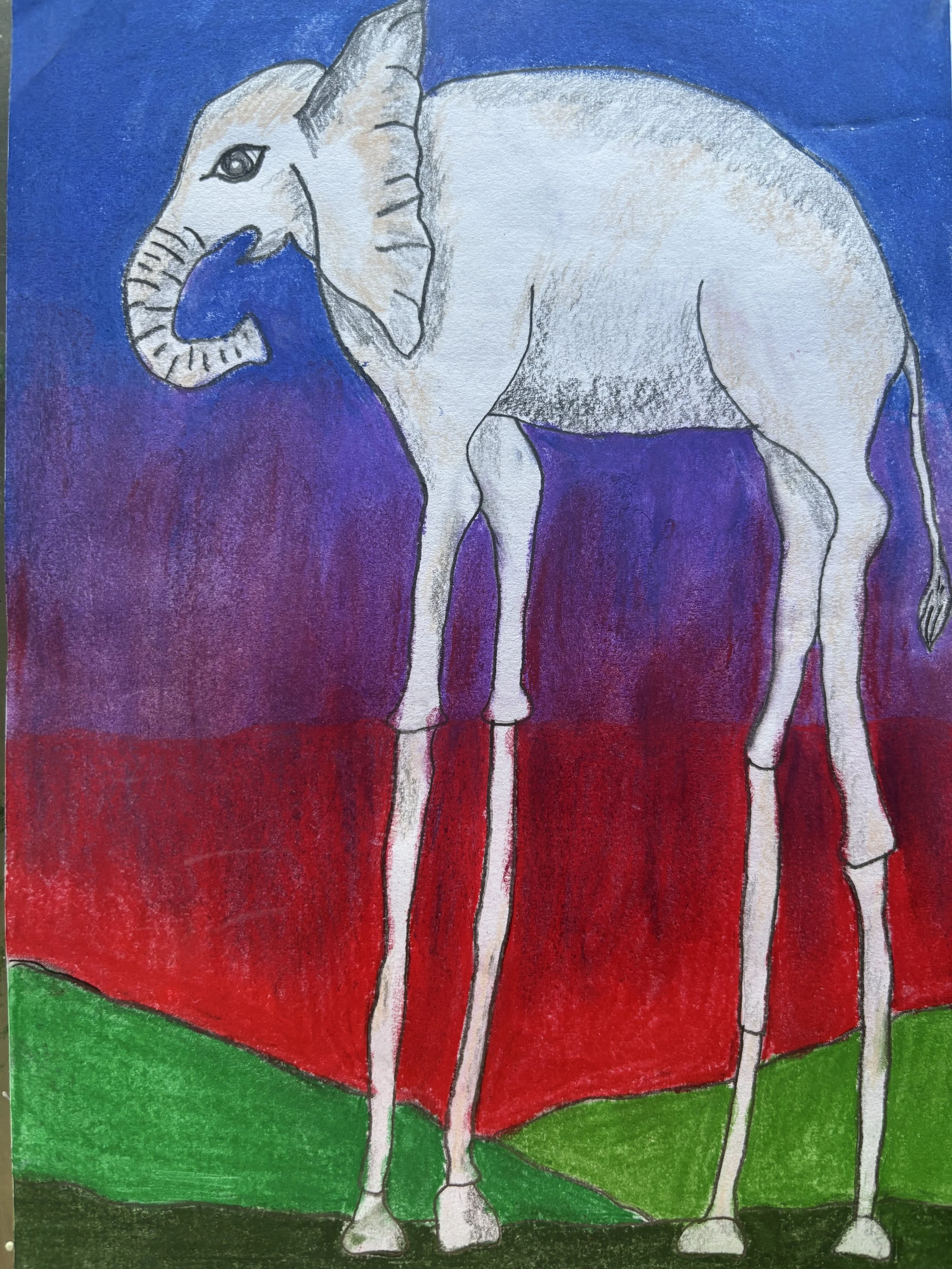
Salvador Dali’s ‘The Elephants’, 1948
Surreal Creatures: Long, Lean & Dreamy
In this delightfully strange lesson, young artists will stretch their imaginations (and their drawings!) by creating an elongated animal inspired by the surreal world of Salvador Dalí. Dalí loved surprising people—both with his unusual artworks and his playful, attention-grabbing personality—and this session celebrates that same sense of fun and curiosity.Children will explore how changing proportions can turn an ordinary animal into something wonderfully unexpected. By bending reality just a little, artists are encouraged to think creatively, take risks and let their imaginations run wild. This engaging lesson shows kids that art doesn’t always have to make sense—sometimes it just has to make you stop, look and wonder. Ele-fant-astic!
-
Orphism, Op Art and Pop Art (1950s–1970s)
Roy Lichtenstein portrait
Pop Art Portraits: Lichtenstein Style
Pow! Bam! Creative Slam! In this bold and colourful lesson, young artists will dive into the exciting world of Pop Art inspired by Roy Lichtenstein, a modern artist born in New York who loved comic strips, everyday objects and eye-catching design. Kids will explore how Lichtenstein used bright colours, strong shapes and a clever printing technique called BenDay dots to make his art look almost machine-made.Artists will learn about the four colours used in printing—cyan, magenta, yellow and key (black)—and create their own BenDay dot sheets to use in a Pop Art portrait. This lesson is part portrait-making, part writing exercise and all fun, encouraging creativity, experimentation and confidence. With dots, colour and personality bursting from the page, kids will love bringing their own Pop Art portraits to life!
Classes may vary slightly from the planned schedule from time to time to best support the group’s creativity and flow.
full day (AGES 5-12)
Classes run from 10am - 4pm ・6 Hours Studio Time
Drop off & Get Ready: 9:25am.
For young artists who simply can’t get enough, our Full Day Art Immersion offers a full day creative adventure. This mixed-age session gives children the time and space to dive deeper into art making, exploring a variety of materials, techniques and art movements across the day.
With time to experiment, create, pause for BYO snacks, and then return to the studio with fresh ideas, artists experience the joy of slowing down and truly immersing themselves in the creative process.
Perfect for families wanting a rich art experience for their child and a relaxed Saturday to themselves.
Where to Find Us
Street parking is available with a 20 minute drop off zone right out the front, making it easy for a relaxed drop-off and pick-up.
47 Banana Street
Redland bay, QLD, 4165
Frequently Asked Questions
-
Not at all! 🎨
Our classes are perfect for all abilities and experience. We focus on creativity, exploration, and building confidence—there’s no “right” or “wrong” way to make art here. -
We welcome kids aged from 5 years and up! Classes are grouped by age as a guide so everyone gets projects that match their skills and imagination.
-
Kids will explore a variety of mediums such as:
Painting
Drawing
Mixed media
Sculpture and crafts
Projects change regularly, so there’s always something new and exciting to try.
-
Yes! All materials are included. Just send your child ready to create in clothes that can get a little messy.
-
For most classes, we encourage parents to drop off and enjoy some free time while we guide the artists. For younger age groups or special sessions, parent participation may be possible—check with the studio.
-
We understand that life happens! Please review our make-up and cancellation policy or contact us—we’re happy to help when we can.
-
You can register directly through our website. If you have questions or need help choosing the right class, feel free to contact us—we’d love to help!
-
Yes! We offer pop-ups, workshops, and special events throughout the year—perfect for first-time visitors who want to try us out, or you can book single sessions during our school term classes.
Still have questions? Feel free to contact us